
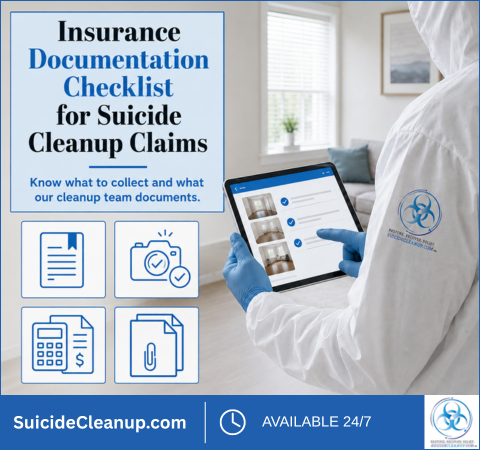
Missing records, unclear estimates, and undocumented approvals can slow a suicide cleanup insurance claim. An organized insurance documentation checklist for suicide cleanup helps you report the loss, gather the correct policy information, understand what to request from the adjuster, and prepare a complete claim packet.
Our nationwide suicide cleanup services include professional assessment, biohazard remediation, scene photography, disposal documentation, and insurance coordination. Our technicians document the affected area and completed work, so you never need to enter the scene, take insurance photographs, handle contaminated belongings, or perform any part of the cleanup yourself.
What Documents Support a Suicide Cleanup Insurance Claim?
A complete claim file connects the incident, insurance policy, property damage, professional remediation, and related expenses. The exact requirements depend on the insurer, policy, and circumstances of the loss.
Follow the numbered checklist below to collect and organize these records at the appropriate stage.
1. Confirm the Scene Release and Open the Claim
Report the loss to the insurance carrier as soon as reasonably possible. You can open the claim before the scene is released and before an official report, professional assessment, or cleanup estimate becomes available.
Professional assessment and cleanup must wait until law enforcement, the medical examiner, or another investigating authority releases the scene. You should not enter the area to collect documentation while the investigation remains active.
What incident information should you record?
The insurer may accept a case number while the complete report remains pending.
- Investigating agency’s name
- Incident or case number
- Medical examiner or coroner reference number, when applicable
- Scene release status or date
- Agency contact information
- Incident report, if available and requested
Tell the insurer when a requested report is not yet available. Do not delay the initial claim notification while waiting for the completed document.
What should you record when opening the claim?
The National Association of Insurance Commissioners recommends contacting the insurer promptly and keeping records of expenses connected to a property claim.
- Claim number
- Date and time reported
- Adjuster’s name and contact information
- Required carrier forms
- Inspection requirements
- Document submission method
- Immediate instructions from the carrier
Keep your description of the incident factual and brief. Our technicians will assess the affected area and document the professional remediation needs after the scene is released.
Clear communication between you, the adjuster, and our cleanup team helps you file a suicide cleanup insurance claim with each document tied to the correct policy and loss.
2. Gather the Policy and Confirm Claim Requirements
Locate the policy covering the affected property. Depending on where the incident occurred, this may be a homeowners, renters, landlord, commercial property, or auto policy.
The insurer determines coverage by reviewing the policy and circumstances of the loss. Complete documentation supports that review but does not guarantee payment.
Which policy records should you collect?
The declarations page summarizes the policy. The full policy and endorsements contain the conditions, limits, and exclusions that may apply.
- Full policy document
- Declarations page
- Applicable endorsements
- Policy number
- Named insured’s information
- Insured property address
- Policy period
- Deductible
- Coverage limits and sublimits
Ask the insurer for a complete policy copy if you only have the declarations page. Confirm that it includes every endorsement active on the date of the loss.
Whether suicide cleanup is covered by homeowners insurance depends on the policy language, property type, physical damage, and circumstances surrounding the incident.
What should you ask the adjuster?
Ask these questions before remediation begins whenever the situation allows:
- Does the carrier need to inspect the property?
- What forms must I complete?
- Is a signed proof of loss required?
- What deductible applies?
- Is there a separate limit for biohazard remediation?
- Are structural damage and personal belongings reviewed separately?
- Does additional living expense coverage apply?
- Does any work require advance authorization?
- Where should estimates and reports be submitted?
- How should newly discovered damage be reported?
Ask the adjuster to confirm important instructions in writing. Financial responsibility and who pays for suicide cleanup depend on the property arrangement, applicable policy, deductible, and final coverage decision.
3. Request a Professional Assessment and Itemized Estimate
Our professional assessment identifies the affected areas, materials, and required remediation. It gives the insurer a documented basis for evaluating the proposed work and estimated cost.
Our technicians perform the assessment and photograph relevant conditions. You do not need to enter the area or prepare your own damage description.
What should the assessment document?
The assessment should explain the extent of contamination and the work needed to address it.
- Affected rooms or areas
- Surfaces and materials involved
- Contaminated porous materials
- Areas requiring containment
- Materials requiring professional removal
- Odor treatment needs
- Biohazard waste handling requirements
- Work needed before structural repairs
The insurer reviews the assessment and proposed work under the applicable policy.
What should the estimate explain?
An itemized estimate separates the project into identifiable work categories. A single total may not give the adjuster enough information to evaluate the cost.
The scope of work explains what must be done and why. The estimate assigns projected costs to that work.
If our technicians discover conditions that change the original scope, we document the additional work. The insurer may request a revised estimate or change order before reviewing the added cost.
4. Organize Professional Cleanup and Contents Documentation
Professional documentation gives the adjuster a record of conditions and completed remediation. Our cleaners take the necessary photographs and document relevant materials throughout the project, so you do not have to enter the biohazard area.
Sensitive photographs should only be taken, stored, and shared for a legitimate cleanup or insurance purpose.
Which cleanup records may support the claim?
Not every insurer requests the same records. Ask the adjuster what belongs in the submitted claim file.
- Initial assessment
- Written scope of work
- Itemized estimate
- Relevant pre-remediation photographs
- Documentation captured during authorized removal
- Relevant post-remediation photographs
- Affected-material records
- Approved change orders
- Final itemized invoice
- Completion report
- Applicable waste transportation or disposal records
Our team provides the technical documentation created during remediation. You remain responsible for completing any policyholder forms requested by the insurer.
How should contaminated belongings be recorded?
Personal belongings and structural materials may be reviewed under different parts of the policy. A separate contents record helps the adjuster identify which items require treatment, disposal, or replacement review.
Our technicians can photograph and document contaminated belongings inside the affected area. You should not handle, relocate, or inspect those items yourself.
When requested, you can provide proof of ownership through receipts, previous photographs, appraisals, order confirmations, or account statements. The NAIC recommends keeping descriptions, photographs, and purchase records as part of a home inventory.
5. Separate Cleanup Costs From Other Claim Expenses
Keep remediation, contents, structural repairs, and temporary living expenses in separate folders. The insurer may review these costs under different policy sections.
Which expense records should you save?
Professional remediation:
- Signed work authorization
- Approved estimate, when applicable
- Change orders
- Final invoice
- Completion report
Structural repair:
- Repair estimates
- Contractor invoices
- Material receipts
- Required permits
- Repair photographs
Temporary living expenses:
- Hotel or short-term rental invoices
- Storage charges
- Additional meal expenses, when applicable
- Transportation expenses requested or accepted by the carrier
Save each receipt, but do not assume every expense qualifies for reimbursement. Confirm applicable limits and authorization requirements with the adjuster.
6. Track Communication and Submit the Claim Packet
A communication log records what the insurer requested, what you submitted, and what remains unresolved. It also helps our team coordinate with the adjuster without sending duplicate records.
What belongs in the communication log?
Use a simple record for meaningful calls, emails, and claim portal updates.
Save emails, letters, portal messages, and notes from telephone calls. Include the claim number in file names and email subject lines.
Confirm verbal approvals or changed instructions by email. Written confirmation creates a clearer record if questions arise later.
How should you review the final claim packet?
Check the packet for missing, mislabeled, or duplicate records before submission.
- Confirm that every document belongs to the correct claim.
- Verify the policyholder’s name and property address.
- Match invoices to the corresponding estimates or approvals.
- Remove unnecessary duplicate copies.
- Confirm that required carrier forms are complete.
- Submit the packet through the insurer’s requested method.
- Ask the adjuster to confirm receipt and identify anything missing.
Keep a complete copy of everything submitted. Retain the coverage determination, payment explanation, invoices, completion report, repair receipts, and settlement documents after the claim closes.
If the insurer limits or denies coverage, request a written explanation identifying the applicable policy language. Ask what reconsideration or appeal process is available before submitting additional material.
Key Takeaways
An insurance documentation checklist for suicide cleanup separates the records you collect from the technical documentation our cleanup team provides. Each record should help the insurer connect the incident, covered property, professional remediation, and claimed expenses.
- Report the loss promptly, but wait for authorities to release the scene before assessment or cleanup begins.
- Record the claim number, adjuster’s contact information, required forms, and submission instructions.
- Collect the full policy, declarations page, and applicable endorsements to confirm limits and claim requirements.
- Ask whether the insurer requires an inspection, proof of loss, advance authorization, or separate documentation for contents and structural damage.
- Let our technicians assess and photograph the affected area, prepare the scope and estimate, and document completed remediation.
- Keep remediation, contaminated contents, structural repairs, and temporary living expenses in separate categories.
- Confirm important approvals in writing and review the final packet for missing, mislabeled, or duplicate records before submission.
Suicide Cleanup Specialists provides discreet professional remediation and insurance documentation support nationwide. Reach out to our team for assistance 24 hours a day.
Frequently Asked Questions
What does insurance documentation for suicide cleanup typically include?
Insurance documentation typically includes incident information, the applicable policy, claim details, professional cleanup records, and related expense documentation. The insurer may request additional forms based on the policy and circumstances of the loss.
How do you file an insurance claim for suicide cleanup services?
Report the loss, obtain a claim number, and ask which forms, inspections, and approvals the insurer requires. After authorities release the scene, our cleanup team can provide the assessment, photographs, scope, estimate, and remediation records requested by the adjuster.
Which companies offer suicide cleanup services covered by insurance?
Suicide Cleanup Specialists provides professional suicide cleanup throughout the United States and works with insurance carriers when coverage applies. The insurer makes the final coverage decision under the terms of the policy.
Are there standard forms for suicide cleanup insurance claims?
No universal form applies to every suicide cleanup claim. Each insurer may require its own property loss forms, proof of loss, work authorization, or submission process.